


The Hidden Costs of Going Cashless | What They Don’t Tell You!
August 12, 2025
UK Budget 2025 Overview: Key Tax Changes, Welfare Updates & Insights!
December 7, 2025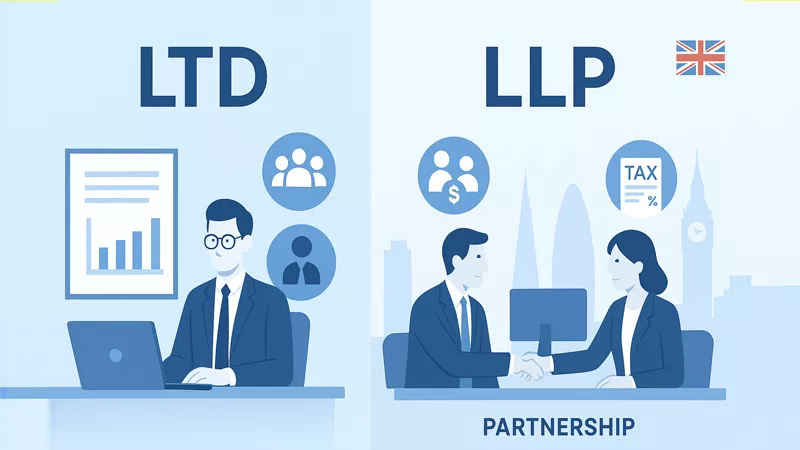
When registering a business in the United Kingdom, two of the most popular legal structures are Limited Company (LTD) and Limited Liability Partnership (LLP). Although many entrepreneurs assume these two structures are similar, the reality is very different. Both entities provide limited liability protection, but they differ significantly in:
- Ownership structure
- Taxation
- Accounting requirements
- Regulatory compliance
- Profit distribution
- Legal responsibilities
- Investor suitability
This comprehensive guide explains every key difference between LTD and LLP accounts in the UK, including how each structure works, filing duties, tax rules, accounting formats, and who should choose which type of entity.
This article is written with deep SEO optimization to rank for keywords such as:
difference between LTD and LLP accounts UK, LTD vs LLP UK, LLP accounts UK, UK accounting requirements, limited company vs LLP, and more.
Chapter 1: Understanding LTD and LLP in the UK
What Is an LTD (Private Limited Company)?
An LTD is a business registered under the Companies Act 2006.
It is a separate legal entity owned by shareholders and managed by directors.
Key characteristics of an LTD:
- Ownership is based on shares
- Minimum one director
- Limited liability protection
- Corporate tax applies
- Dividends can be issued
- Ownership transfer is easy
- Suitable for raising investment
What Is an LLP (Limited Liability Partnership)?
An LLP is governed by the Limited Liability Partnerships Act 2000.
It is a partnership with limited liability where partners share responsibilities, profit, and decision-making.
Key characteristics of an LLP:
- Minimum two designated members
- No shareholders or directors
- Members (partners) own and manage the business
- Profit is shared according to the LLP agreement
- Partners pay income tax on profit share
- More flexible than a traditional partnership
Chapter 2: Ownership Structure — LTD vs LLP
LTD Ownership Structure
- Shareholders are the owners
- Directors manage daily operations
- One person can be both director and shareholder
- Ownership is transferable by selling shares
This makes LTDs attractive for:
- Startups
- Tech companies
- Businesses seeking investors
- Companies planning to scale
LLP Ownership Structure
- Owned by partners
- Managed collectively
- Partners sign an LLP agreement
- Profit-sharing is flexible
- Ownership changes require partnership agreement updates
LLPs are preferred by:
- Lawyers
- Accountants
- Consultants
- Creative agencies
- Other professional service firms
Chapter 3: Accounts & Filing Requirements
This is the most important section for SEO, as it explains the accounting differences in detail.
LTD Accounts Filing Requirements
An LTD must file accounts to two authorities:
1) Companies House
Required filings include:
- Statutory Accounts
- Balance Sheet
- Profit & Loss Statement
- Notes to Accounts
- Director’s Report (not always required for micro-entities)
- Cashflow Statement (medium/large companies)
2) HMRC
The company must file:
- Corporation Tax Return (CT600)
- Full annual accounts
- Tax computations
LTD Filing Deadlines:
- First accounts: up to 21 months after incorporation
- Annual accounts: 9 months after accounting year-end
- Corporation tax return: 12 months after year-end
3.2 LLP Accounts Filing Requirements
LLPs also file to Companies House and HMRC, but the process is different.
Companies House requirements for LLPs:
- LLP annual accounts
- Balance Sheet
- Profit allocation statement
- Members’ details
- Notes to accounts
HMRC requirements:
- Partnership tax return
- Each partner must file a self-assessment return
- Each partner pays tax individually
LLP Filing Deadlines:
- Annual accounts: 9 months after year-end
- Partnership tax return: 31 January (online)
- Individual members’ tax returns: 31 January
Taxation Differences — LTD vs LLP
This chapter explains the tax treatment, the biggest practical difference.
LTD Tax Structure
LTDs pay tax at the corporate level.
Taxes applicable to LTD:
- Corporation Tax on profit (currently 19%–25%)
- Dividend Tax when shareholders receive dividends
- Income Tax + National Insurance on director salaries
- VAT if turnover exceeds the threshold
LTDs allow greater tax planning flexibility, such as:
- Salary + dividend mix
- Allowable business expenses
- R&D tax credits for innovative companies
LLP Tax Structure
LLPs do not pay corporation tax.
Instead:
Each partner pays:
- Income Tax on personal profit share
- Class 2 & Class 4 National Insurance
- VAT (if applicable)
Tax Transparency
LLPs are “tax transparent”—profits pass directly to partners.
LTD vs LLP Tax Comparison Table
| Category | LTD | LLP |
|---|---|---|
| Who pays tax? | The company | Individual partners |
| Tax rate | Corporation tax | Income tax |
| Dividend tax | Yes | No |
| NI contributions | On salaries | On all partner profits |
| Tax planning | Higher flexibility | Limited flexibility |
Account Presentation Differences
LTD Accounts Include:
- Balance Sheet
- P&L Account
- Share Capital
- Dividends & Retained Earnings
- Director’s Report
- Notes
- Cashflow Statement (if applicable)
LLP Accounts Include:
- Balance Sheet
- Profit Allocation Statement
- Capital Accounts for each member
- Selected disclosures
- Notes signed by a designated member
Unique Differences
| Feature | LTD | LLP |
|---|---|---|
| Dividends | Yes | No |
| Profit Allocation | Not required | Must be shown |
| Personal tax involvement | Low | High |
Liability Protection — LTD vs LLP
Both LTD and LLP provide limited liability protection, but the mechanics vary.
LTD
Shareholders are liable only up to unpaid share capital.
LLP
Partners’ liability is limited to capital contribution, but operational negligence may create personal exposure.
Which Structure Is Better?
Choose LTD if you:
- Want investors
- Want easier ownership transfer
- Want lower tax using salary+dividend mix
- Plan to scale the business
- Prefer clear separation of ownership and management
Choose LLP if you:
- We are a professional services firm
- Want flexibility in profit sharing
- Want transparent taxation
- Work in a partnership environment
- Want a collaborative management structure
Practical Examples
Example 1:
Tech Startup → LTD
Needs investors, shares, and scalability.
Example 2:
Law Firm → LLP
Partnership-based professional model.
Example 3:
E-commerce Company → LTD
Example 4:
Consultancy Team → LLP
Cost Comparison
| Cost Area | LTD | LLP |
|---|---|---|
| Registration | £12–£50 | £10–£50 |
| Accounting Fees | £500–£2000+ | £600–£2500+ |
| Legal Fees | Lower | Higher (partnership agreements) |
| Annual Compliance | Simpler | More partner-level tasks |
Conclusion
While LTDs and LLPs both offer limited liability, the ownership, taxation, and accounting requirements differ significantly. If your goal is to raise investment, scale the business, or enjoy structured taxation, an LTD is usually the best choice.
If you prefer partnership flexibility and profit-sharing transparency, an LLP is ideal.
Understanding these differences ensures you pick the structure that offers the best legal, financial, and operational advantage for your UK business.
Frequently Ask Question
An LTD is a company owned by shareholders and taxed via corporation tax, while an LLP is owned by partners who pay income tax on their profit share.
LTDs generally offer better tax planning options due to salary + dividend flexibility, whereas LLPs have simpler but often higher personal tax rates.
Yes. LTDs file statutory accounts and a corporation tax return. LLPs file partnership accounts and each partner must submit a self-assessment tax return.
No. LLPs have partners, not shareholders, and profit is shared based on an LLP agreement.
LLPs are ideal for law firms, accountants, consultants, and agencies that operate through partnerships.
LTD is the best choice because it supports shares, equity, investors, and easier ownership transfer.